


What if you could get almost all of your residents using 100% renewable electricity?
It might be easier than you think… 37 municipalities in Massachusetts have already done it! There are a few paths to explore. And one vital last step - make your 100% renewable option the default for your residents.
Why is this key? Because in municipal aggregation programs, 90%+ of the consumers are typically using the default option. So, you can have the most significant impact, with minimal effort, by cleaning the default option. And, as the market stands today (June 2026), there is nearly a cost neutral approach to doing this called national wind RECs (details below).
What if your default program was 100% renewable? The DPU data shows that often more than 90% of subscribers sign up for (or stick with) the default option. Sometimes, those default options are a little more expensive than the other options. But people sign up for them anyway. Human nature is a wonderful thing! So why not leverage it for a more sustainable future? Your community could shift from incremental change to immediate, large-scale impact.
We at Green Beverly believe that a sustainable future should be the easiest choice for your residents. A 100% renewable default leverages the purchasing power of your municipality to stabilize energy costs, protect citizens from the volatility of fossil fuel markets, and drive a more sustainable future.
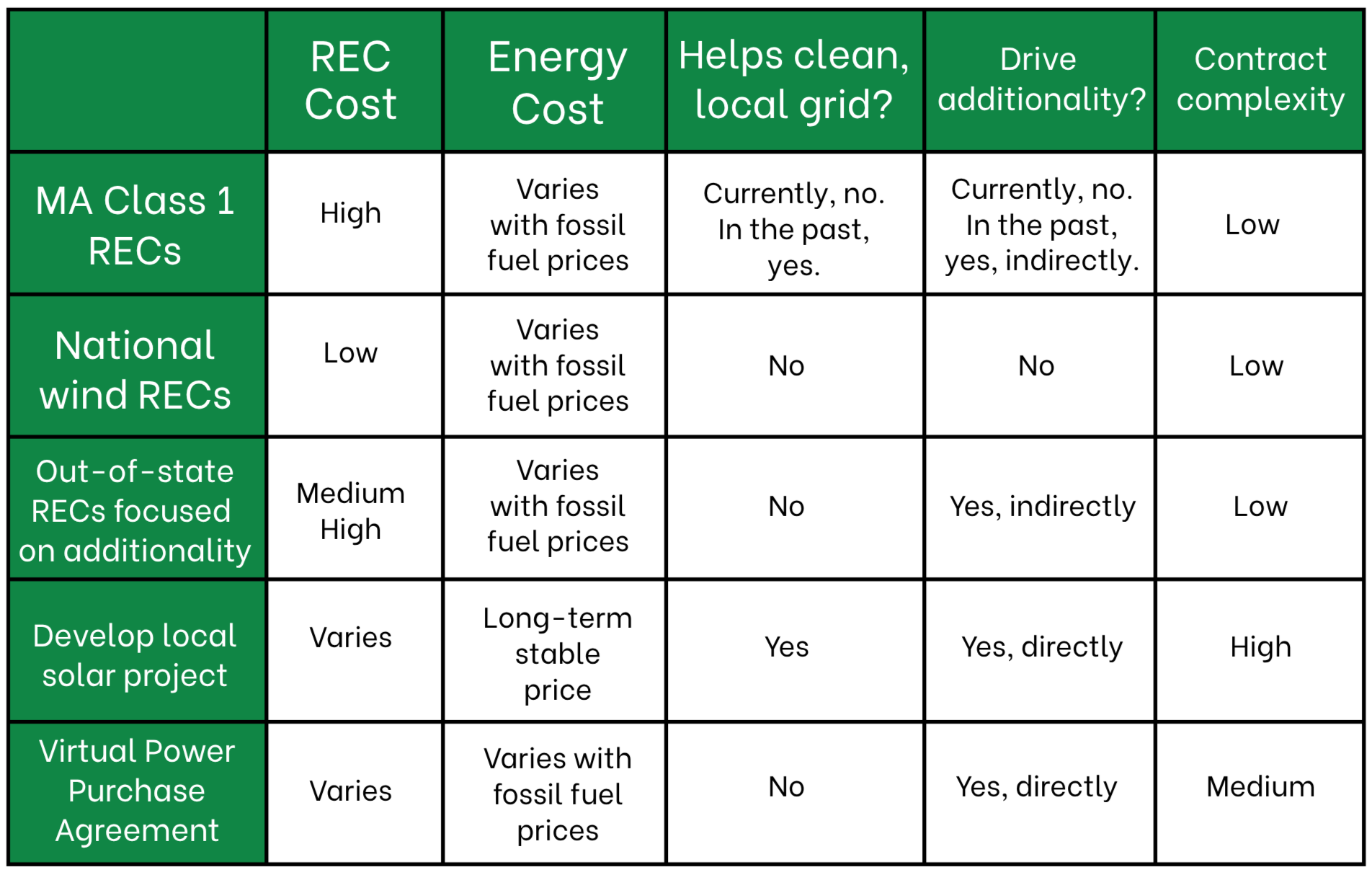
As things stand, electricity sold in Massachusetts must be at least 69% renewable. So, to have a 100% renewable offer, municipalities need to find a way to purchase the remaining 31% from renewable sources. There are a few possible paths, including:
Buying additional Massachusetts Class 1 RECs. A potentially powerful option, but this type of REC is expensive and can make consumers’ bills significantly higher. And that makes it a nonstarter as the default option for most communities. Historically, this higher REC price has been used to indirectly drive additionality (see FAQ below), encouraging renewable energy developers to build new projects on our grid. However, obstacles to new renewable projects in New England remain. For example, federal government support for renewables has diminished, and land in Massachusetts tends to be more expensive than in many other parts of the country. So projects that should be incentivized by these RECs are currently less likely to be built. The value of paying a high price for Massachusetts Class 1 RECs isn’t clear at this point (June 2026).
Buying national wind RECs. This is a very cost effective way to claim 100% renewable energy. Although these RECs support the renewable energy industry, they typically don’t drive additionality (like their Class I REC counterparts) because they come from older projects. These wind projects typically come from a region that runs anywhere from down in Texas right up to the Dakotas. So, buying these RECs has no impact on cleaning the local grid. But, topping up to 100% renewable energy with national wind RECs can add less than 0.1 cents per kWh to residents electricity bills - making it a very cost effective solution as the default energy offering. Although not the ideal solution, it’s a step in the right direction and potentially a powerful way to get residents excited about taking a big step in their sustainability journey.
Buying out-of-state RECs focused on additionality. Many other states have RECs designed to drive additionality, similar to Massachusetts Class 1 RECs. So while MA Class 1 RECs can’t drive additionality at the moment, other states can potentially fill that gap. These out-of-state RECs include California’s PCC1 RECs, New York Tier 1 RECs, and PJM Tri-Qualified Tier 1 RECs. It’s worth remembering that other grids still burn coal for power generation; the Massachusetts grid (ISO New England) does not. So buying RECs from out of state could have a larger impact on reducing emissions overall.
Working with a developer to build a local solar project. A more sophisticated, but potentially very worthwhile approach. This solution could bring many benefits - although it does take more effort to execute. Called a Physical Power Purchase Agreement (PPA), it would enable a muni to lock in a long-term, stable, and competitive price for energy. In addition, working directly with a renewable energy developer on the project would guarantee additionality. Local job creation and increased tax revenues are also potential gains. Weighed against that, a municipality would need to commit to an energy price for much longer than a traditional municipal aggregation agreement.
Signing Virtual Power Purchase Agreement (VPPA). A Virtual Power Purchase Agreement is another powerful way to directly drive additionality. With a VPPA, the municipality would work directly with a developer to support a new renewable project out-of-state, on another grid. The long-term commitment of the muni (and often other buyers) is necessary for the developer to secure the finance to build the project. VPPAs are sophisticated financial agreements - much more so than a regular energy purchase. They provide the potential for municipalities to both generate revenue or to be a cost. They require careful evaluation, but the City of Cambridge selected that option.
The table below provides a summary of the attributes of the different solutions above.
See the FAQ below for more insights.
-
A: Yes, even if you choose 100% renewable energy, some of your electricity will come from fossil fuels. Your electricity supply is made up of electrons, and one electron looks and behaves just just like any other. They are identical. So when electrons get pushed into the grid, it’s impossible to know if they come from a renewable plant or a fossil fuel plant. Imagine you’re making a smoothie, with strawberries and blueberries. Once you blend the fruits together, you can never separate them out. Every sip you take will contain both strawberries and blueberries. And the same applies to electricity. Once electrons from fossil fuels and electrons from renewable plants are on the grid, you inevitably consume both. Fortunately though, RECs are used to help keep track of renewable energy generation and consumption.
-
A: REC is short for Renewable Energy Certificate. Every time a chunk of renewable electricity gets generated a REC gets created with it. (Technically, that chunk is called a megawatt hour by energy nerds). RECs can be bought and sold in marketplaces, pretty much like any other commodity - stock in your favorite company, soybeans, natural gas, gold - and so on.
Whoever owns that REC can take pride in knowing that they have helped combat climate change. That’s because if you paid to buy a REC that shows that you paid to support the generation of renewable electricity. It’s true that some RECs are better at combating climate change than others (they aim to encourage additionality). But ultimately, the more RECs you have in your municipal aggregation program, the more you are supporting renewable energy and combating climate change.
-
A: Massachusetts (MA) Class 1 RECs are not necessarily generated at renewable plants in Massachusetts! MA Class 1 RECs can come from any qualifying plant in what is called ISO New England (our local grid). Plus some next-door neighbors too…
ISO New England (ISO-NE) is the electricity grid that includes Massachusetts. But, the clue is in the name - ISO New England also includes Connecticut, Rhode Island, New Hampshire, Vermont, and most of Maine. And those next-door neighbors would be northern Maine, New York, Quebec, or the Canadian Maritime Provinces. In New England, we get power from hydro generation in Quebec, for example. So, a Massachusetts Class 1 REC can be created in any of those regions. So in summary, if you sign up for MA Class 1 RECs your renewable energy may not be generated in Massachusetts.
-
A: National wind RECs are both abundant and very affordable. So they are easy to source for long-term energy contracts at low cost. That means they can be added to municipal aggregation contracts with minimal impact on consumer rates. For example, the City of Beverly’s 100% renewable offer costs only 0.07c more per kilowatt-hour than the basic product that meets the state minimum requirements. Likewise, North Andover’s 100% renewable offer using national wind RECs is only 0.1c per kwh more expensive than the basic product. West Newbury’s is just a tad more expensive than that…
While buying national wind RECs clearly supports renewable energy, these RECs do have limitations. First, they come from outside New England, typically being sourced from renewable energy projects anywhere between Texas and North Dakota. So, they lack direct support for the region - no local taxes, no local employment, no lease payments to local farmers or land owners. On the other hand, most of the electricity grids outside New England are more carbon-intensive. They still burn coal for power generation. So RECs from outside New England may actually have a greater impact on carbon dioxide emissions overall.
National win RECs also have minimal additionality claims. True additionality means your REC investment directly leads to a new renewable energy project being built - one that simply wouldn’t have happened without your financial commitment. National wind RECs are generated by existing renewable projects, so the additionality claims are weak.
Additionality is desirable and we should strive for that. But, there’s a bigger picture - sustainability isn’t just about clean energy. Including low cost national wind RECs can help residents feel positive about their contribution to combating climate change. What if that was a powerful first step into sustainability and spurred them into other acts - recycling, composting, reducing water usage, composting, safeguarding habitats…?.
-
A: Probably not. Even if you are in an aggregation plan that claims to deliver 100% renewable electricity, it almost certainly isn’t 100% renewable, 100% of the time. That’s because of the constant changes in electricity demand and supply that occur hour to hour, day to day, season to season. The grid that we’re part of in Massachusetts is ISO New England. Depending on the time of day, or day of the year, somewhere between 10% and 60% of the electricity is generated from natural gas. Energy nerds can see today’s fuel mix here.
In the US, a typical home consumes between 10 and 12 MegaWatt hours (MWh) of electricity a year. To keep the math easy, say your home consumes 12 MWh each year. If you are in a plan that provides 100% renewable energy, that means 12 RECsare bought and retired for you each year. But, that’s based on how much you consume over the whole year. It doesn’t allow for peaks in your (and other consumers) demand. So, at times of high demand, when more electricity is needed, you are almost certainly using electricity generated by natural gas. For example, during a recent hot day in June, natural gas supplied almost 70% of our electricity during the evening peak.
As the renewable energy industry matures, we’ll evolve from matching RECs to your annual consumption to what’s known as hourly matching. That will ensure that people with 100% renewable energy plans are 100% renewable all the time. We’re not quite there yet. If you’re in a plan that claims to deliver 100% renewable energy, thank you. You’re doing something very impactful to fight climate change.
-
A: I’m so glad you asked! To tackle the climate crisis, we need to build more renewable energy generation as fast as possible. Any action we take that leads to additional renewable energy sources being added could be called additionality.
Add solar panels to the roof of your house? Nice, that’s additionality.
Commit early to a large-scale renewable energy as T-Mobile did? That’s additionality too.
Add a solar canopy to the high school parking lot? You’ve got additionality.
Other indirect ways are also used to try and encourage additionality. One of the most common is to keep REC prices high. This is the approach taken by several ISOs (the formal name for an electricity grid). For example, in New England we have Massachusetts Class 1 RECs. Other parts of the country have similar RECs too. For example, California has PCC-1 RECs, New York has Tier 1 RECs, PJM also has Tier 1 RECs. In theory, high REC prices attract renewable energy developers as they can generate more revenue from their projects.
But other factors - such as high land prices, difficult permitting processes, and long interconnection lead times - can create obstacles that prevent new plants being built. And, when you’re relying on high REC prices to drive additionality, the direct linkage between a REC and a specific renewable energy project is lost. So the additionality claim is not as strong as the earlier examples listed above.
-
A: If you haven’t read about additionality, do that first. Because emissionality is additionality taken a step further. Additionality describes adding new renewable energy generation to combat climate change. Emissionality takes it a step further by deliberately adding new renewable capacity where it can have the biggest impact on reducing greenhouse gas emissions.
It’s great when we can add new renewable energy generation close to home, on our local grid (called ISO New England). But, ISO New England is already a relatively clean grid. We have natural gas fired generation, but no coal. Coal produces roughly twice as much carbon dioxide for every unit of energy generated, compared to natural gas. Many other places in the US - such as Texas, the mid-west, or Tennessee - still burn significant amounts of coal for power generation. So, ensuring additionality is focused in locations that generate large amounts of carbon dioxide (ie. use coal) can have a much greater impact on climate change overall. And that’s what emissionality is. Some renewable energy developers, such as Clearloop, specialize in building new renewable energy projects where they can have the greatest environmental impact.
Lexington Case Study

-
The Town of Lexington, Massachusetts, located just northwest of Boston, is celebrated as the birthplace of the American Revolution. With a population of over 34,000 and a median income above $230,000, Lexington is a progressive community with highly engaged and educated residents. Today, Lexington is a pioneer within the Commonwealth, particularly regarding sustainability and climate resilience.
Governance in Lexington balances municipal leadership with active resident participation. The Town’s executive policy setting body is its five-member Select Board, while Town operations are managed by the Town Manager. The Town’s many Boards and Committees also play a central role in moving forward policies, planning, and programs. The Town has a Sustainability & Resilience Officer who is responsible for advancing Lexington’s climate and sustainability goals.
-
Lexington’s formal commitment to community-wide decarbonization gathered momentum over a decade ago. In 2014, the Sustainable Lexington Committee conducted a baseline emissions analysis and identified the town's two largest sources of greenhouse gas (GHG) emissions, Lexington’s buildings and vehicles. As Select Board member Mark Sandeen notes, “If we wanted to remove those emissions we needed to electrify both our buildings and our vehicles. But there's a much higher benefit when you’re using electricity that is 100% renewable.”
At that time, the Massachusetts Renewable Portfolio Standard (RPS) was increasing at a rate of only 1% per year. Although that was more progressive than many other states, it implied the local grid would not achieve complete decarbonization until the year 2095! As Mark continues,”We identified that buying additional RECs through our municipal aggregation was the best way we could make a significant impact.”
-
After securing Town Meeting approval - and navigating state regulatory reviews through the Department of Energy Resources (DOER) and the Department of Public Utilities (DPU) - Lexington officially launched its municipal aggregation program in July 2017. Lexington created a simple yet compelling message to share with the public: Cheaper and cleaner.
The approach then - and now - is to drive additionality while offering low, stable rates compared to Eversource’s Basic Service rate. The initial aggregation program included a default offer (100% Green) that included an additional 5% of Massachusetts Class 1 RECs over and above those required by the state. The remaining RECs to achieve 100% renewable energy came from national wind RECs. All for less than the utility’s default Basic Service. Cheaper and cleaner.
When negotiating a new aggregation contract, the Town Manager and the Sustainability & Resilience Officer work with their consultant (Peregrine Energy Group) to secure market quotes. Indicative rates are then shared with the Select Board in an executive session, and the Board authorizes the Town Manager to execute a contract on their behalf. The Town has always made the default aggregation program 100% renewable. Human nature being what it is, most residents stick with the default. But options are always available to opt up to the New England Green option with a total of 100% MA Class 1 RECs. Likewise, subscribers can opt down to the Basic option that only provides the state minimum renewable content. In this way, each subscriber can choose the right balance of renewable energy and price.
Over the years, the exact renewable content has varied. Currently, the optional renewable energy portion of the default program consists of national wind RECs. Unfortunately, with current circumstances, there is very little renewable energy being added in New England at the moment. As Sustainability & Resilience Officer Maggie Peard noted, “Right now, if we bought additional MA Class 1 RECs, we would just be paying for additionality that isn’t being built. Hopefully that will change soon.” While national wind RECs aren’t the perfect solution, they are a cost effective stop-gap.
-
Lexington still has renewable energy ambitions. The Town is exploring options to integrate a solar project into their program under the state's Low-Income Community Shared Solar (LICSS) initiative. “We’re close to having approvals from the DPU and DOER”, shared Maggie Peard. “Soon we’ll have the money from solar incentives accumulating in a fund and then we’ll be able to start reducing energy costs further for our low-income residents.”
Beyond LICSS, Mark Sandeen sees new potential to drive additionality locally. “Solar energy is cheaper than fossil fuel now. What if we could just buy the energy directly? If we worked directly with a solar developer we could lock in a long-term low price for energy and get local additionality too.” That may be ambitious, but Lexington has recently amended its bylaws to allow energy contracts to be longer than 20 years. Watch this space…
-
Lexington’s lengthy experience offers some potential guidance for other towns and cities:
Watch the market to time your contract renewal: When you go to market to renew your community choice aggregation program matters. It can impact the price your residents pay for both energy and top up RECs. To optimize this, Peregrine Energy helps the Town monitor energy markets.
Adapt to shifting regulatory and market realities: Historically, Lexington has always included voluntary MA Class 1 RECs to help drive the build out of renewable energy plants in our grid (ISO New England). That commitment came with a premium price tag, but the trade off was worthwhile. Now, with new renewable energy builds facing strong headwinds in our region, that no longer makes sense. The Town has adjusted to this new reality while it looks for a new way to maximize its impact on climate change. There are many different ways to deliver renewable energy for your residents, consider exploring all the options.
Explore long-term energy contracts (power purchase agreements) as a way to hedge against rising energy costs: Renewable energy systems have very low operating costs - unlike say, a gas peaking power plants. And the per megawatt cost of solar energy and energy storage systems is still dropping rapidly. This provides a unique opportunity to lock in low long-term energy costs from renewable sources. But, that requires a new approach to energy procurement - and municipal policies to match.

Cambridge Case Study
-
With a population of more than 120,000 and a median household income north of $143,000, Cambridge is a leader in sustainability. It is one of the first nineteen communities in Massachusetts that were recognized by the state as a Climate Leader Community in April of 2025. It is also the only community in Massachusetts to endorse the Plant Based Treaty, highlighting the role of plant-based food strategies in sustainability and countering climate change.
-
Sustainability projects in Cambridge include building decarbonization, climate resilience, green transportation, urban forests, and zero waste. The Cambridge Community Electricity (municipal aggregation) program plays its part too. Meghan Shaw is responsible for climate strategy & implementation for the City of Cambridge. Meghan first moved to Cambridge for her career, joining the Cambridge Energy Alliance. Founded by the city as a non-profit, it was later incorporated into the city government. From there, starting with Mass Save, Meghan drove the growth of clean energy programs. That included rooftop solar, multi-family energy pilots, and the launch of the municipal aggregation program, starting in 2017.
-
“As I've gotten more familiar with municipal aggregation, the City and I have really come to see it as a very powerful tool to drive decarbonization,” says Shaw. Right from the first program in 2017, the City of Cambridge has always had a laser focus on driving additionality, or adding new renewable generation to the electric grid. In the first aggregation program, the City used Massachusetts Solar Renewable Energy Certificates (SRECs) to add renewable energy above the state minimum requirement. (SRECs provided a strong financial incentive to drive new on-site solar installations in the state). MA Class 1 RECs have also been used in the past. Cambridge has always included a small adder to its muni aggregation program to fund sustainability projects. For example, three years of funding from the adder were used to install on-site solar on a local elementary school. Although installed on the school roof, all electricity produced is sent to the grid. The RECs generated are retired on behalf of the muni aggregation participants. The net-metering credits are sold, and the revenue deposited back into the aggregation's revolving fund.
Shaw noted, “It’s a great model, but very hard to scale. Cambridge is a dense city. We don't have a lot of rooftops that we can just keep building aggregation solar projects on.” It wasn’t possible to meet the renewable energy needs of the aggregation program that way. It also became clear that the Department of Public Works wouldn’t be able to meet the future renewable energy needs of the City’s municipal buildings either.
In parallel with this, Cambridge was introducing a policy that required large non-residential properties to track, report, and reduce their emissions - known as Building Energy Use Disclosure Ordinance (BEUDO). BEUDO is a key part of the City’s strategy to achieve net zero emissions by 2050. Not only does it help individual organizations to reduce their emissions, but the aggregate view provides data that helps the City to create effective policies and incentives. Notably, almost 30% of the buildings covered were owned by colleges and universities. With the introduction of BEUDO, local corporations and organizations - such as Harvard University, MIT, and Biogen - formulated their greenhouse gas emissions reduction goals. And that seeded an idea…
“We did a strategy project with the consulting firm ARUP, a local renewable energy procurement group called the Sustainability Roundtable Inc., and Peregrine Energy Group, our aggregation consultant,” she continued. “Over 18 months, we developed a long-term renewable energy strategy.” It became clear that a virtual power purchase agreement (VPPA) could be the best option to meet the City’s needs. But there were two potential snags. First, VPPA’s are usually executed by organizations with a very large electricity load. And Cambridge doesn’t have that. Second, it wasn’t clear if the City could legally combine its load with other smaller organizations to execute a VPPA. And so the City turned to PowerOptions, a specialist in non-profit energy procurement throughout New England.
Through PowerOptions, the City was able to join with Harvard University, MIT, Mass General Brigham Healthcare and several other organizations to pursue an aggregated virtual power purchase agreement. 3Degrees consulted on, and facilitated the contract. Through this agreement, the City of Cambridge obtained RECs from a yet-to-be built wind project in Bowman County, North Dakota, which came online at the end of 2025. Not long after, the City also signed a similar agreement for the yet-to-be-built Prairie Solar plant in Illinois. Sustainability Roundtable, Inc., was the consultant and facilitator for this agreement. RECs from both projects are added to the state minimum required for the municipal aggregation to take the default program option to over 100% renewable energy.
Crucially, the City also has a strong additionality claim. “Without the upfront, long-term financial commitment of the City (and other organizations) those projects may never have been built,” Meghan Shaw explains, “The City has a triple-A bond rating, as do Harvard and MIT, so we’re all very creditworthy. That means those two renewable energy developers can go to the bank and get the financing that they need because they can say I've sold 100% of my projects’ generating capacity.”
It’s also notable that both projects are in MISO, the electricity grid that operates in the mid-west. There are two benefits to this. First, it’s less expensive to buy RECs in MISO that drive additionality. Second, the MISO grid operates a much more carbon intensive grid than the New England grid, as it uses coal as a fuel source. So by building new renewable generation in MISO the reduction in overall carbon emissions is much greater. While those two 15-year virtual power purchase agreements lock in RECs for the long-term, energy supply contracts for the aggregation’s electricity supply are still negotiated separately with the aid of Peregrine.
-
With the City of Cambridge pioneering the virtual power purchase agreement for municipal aggregation, what can other munis learn from this approach?
It requires a big effort and a long lead time: Compared to most municipal aggregation programs, the City of Cambridge approach is a big lift. Overall, from concept to delivery of the RECs, the project took about 6 years. Many consultants and third parties were also involved in the planning and execution. To be fair, the COVID pandemic slowed the project, and it would be quicker to execute the second time around (as discussed).
Consider how you can have the biggest impact: For most municipalities, the choice of additional RECs is either Massachusetts Class 1 RECs or national wind RECs. Both have their pros and cons. But as the City of Cambridge has shown, there are other options that offer different trade-offs on additionality, cost, and the impact on climate change.
Benefits of a long-term contract does bring some risk and uncertainty: Most municipal aggregation agreements buy energy and RECs at the same time. And their contracts are relatively short - 12 to 48 months is typical. That limits the financial risk. While a 15-year VPPA does bring high quality RECs that drive additionality, there is some risk to that. Virtual power purchase agreements inherently mean REC prices are going to be less predictable over the lifetime of the contract. That’s just how VPPAs work. So any muni that enters into a VPPA must ensure they understand that financial risk and take steps to manage it. The muni - and other organizations it partners with - will also need a strong credit rating for a VPPA to be possible.
Watertown Case Study

-
Watertown was one of the first nineteen communities to be certified as a climate leader in Massachusetts in 2025. This leadership is illustrated by the new Watertown High School, designed to be the first LEED Platinum 4.0 and Net Zero Energy high school in the United States. The City has a population of almost 36,000, and a median household income of more than $126,000.
Governance consists of a nine person City Council, with a full-time City Manager. The many Boards and Committees include the Environment & Energy Efficiency Committee which is a team of seven appointed by the City Manager and confirmed by the City Council.
-
Watertown has been a sustainability leader for many years:
It was one of the first communities in Massachusetts to receive a Green Community designation in 2010, and later was certified as one of the Commonwealth’s first Climate Leader Communities in 2025.
It was the first city in New England to require solar panels on 90% of the area of parking garages and 50% of roof coverage on new or redeveloped buildings of a certain size.
The City has received two Municipal Vulnerability Preparedness Action Grants for a program that uses nature-based solutions to create climate resilient neighborhoods.
In addition to the high school, Watertown also designed and built two of the first Net Zero Energy school buildings in the Commonwealth when it replaced its elementary schools.
Watertown also adopted the state’s Specialized Stretch Energy Code in 2023, requiring new construction to meet higher standards in energy efficiency.
-
Laurel Schwab currently leads the Sustainability Team in Watertown, joining the City in 2019. Em Schule serves as the Energy Advocate, and Silas Fyler as the Assistant Director for Energy Management. “The Watertown Environment & Energy Efficiency Committee was established in 2003. They were the driving force behind much of the City’s early sustainability work,” said Laurel Schwab. Ed Lewis, Watertown’s first (and former) Energy Manager, helped establish a municipal aggregation program in 2019.
As Em Schule noted, “There was a long period of public consultation and education. Ed would go out and meet people at events, talk with them, and hold public meetings to discuss municipal aggregation.”Today, there are over 10,000 residential customers signed up for the municipal aggregation program, and over 1,000 businesses, furthering the City's climate and energy goals. The program is managed by Silas Fyler, Assistant Director for Energy Management, who is always aiming to serve the residents as best the City can. “I always aim for low rates, and track prices and evaluate options throughout the year”, explained Silas. “Generally, we renew every three years, but it depends on what’s happening in the market, and pricing projections. Residents are very sensitive to electricity price changes.”
As Silas continued, “Historically there’s been a strong argument for MA Class 1 RECs. They can help the state achieve 100% renewable energy generation by 2050, they can build local skills, and create local jobs. And we support those goals inWatertown. But, right now, it doesn’t look like MA Class 1 RECs can fully support those aims with the changes at the national level.”
There’s typically a huge difference between the prices of the different types of RECs. That price difference is reflected in consumers' bills as the cost is passed through. Currently, Watertown’s default offer is 100% renewable energy. The voluntary 31% over and above the state requirement of 69% renewable is a mix of Renewable Energy Certificates (RECs). Five percent is Massachusetts Class 1 RECs, with the remaining 26% coming from national wind RECs. At the moment, that combination of RECs provides some support for the growth of local renewables, jobs, and skills. But it also makes the default option affordable, which means over 90% of residents stay in the default 100% renewable program.
-
2027 will usher in an update to the five-year Resilient Watertown Climate and Energy Plan. As Laurel noted, “I’m excited to see what ideas the community wants us to include.” The City will also continue to aggressively add solar to municipal buildings and electric vehicles to its fleet when it’s prudent to do so.
-
With Watertown committed to municipal aggregation, what can other munis learn from the City’s approach:
A balanced approach to RECs can ensure your default offer remains affordable for residents. The City’s default offer supports local renewable energy development through its voluntary addition of Massachusetts Class 1 RECs. But, it also adds voluntary national wind RECs to make the offer 100% renewable energy. That blend makes the default offer affordable - it’s only 0.3c more expensive than Watertown’s basic offer that has no additional renewable energy. And, it’s over 3.5c cheaper than the Eversource basic service. That’s a powerful compromise of 100% renewable energy and affordability.

Ashfield Case Study
-
Ashfield nestles in the foothills of the Berkshires in western Massachusetts. The population is roughly 1,700. In Ashfield, responsibility for policy, strategy, and budgeting hinges on a three-member select board. Policies are executed by the Town Administrator. There are a number of boards and committees that focus on specific areas. One committee is the energy committee, chaired by Alexandra Osterman.
Alexandra herself has been involved in sustainability for a long time. Starting in college, Alexandra couldn’t find the path that she wanted. “So I was able to design my own major called motivations and methods for environmental change”, Alexandra noted. That brought together psychology and the understanding of what motivates people, together with all the traditional environmental studies courses. Ultimately settling in Ashfield, she started volunteering on the town’s energy committee in 2022.
-
Ashfield had been invited to join the Franklin County aggregation, which started in 2020. But, the town felt the timing wasn’t quite right, and declined the invitation to participate. However, the Ashfield Energy Committee brought this idea back into play in 2022, and in 2023 they brought the idea to a town meeting. As Alexandra Osterman noted “Our intention was to get people to green their electricity and cut their energy costs, have it be a win-win for everybody.” Alexandra continued, “This is something everyone in town could get behind no matter their politics or feelings about renewable energy.” Municipal aggregation easily gained approval at the town meeting.
Moving forward with the plan, the state requirements at the time was that at least 63% of each option in a muni aggregation program had to be renewable. However, the energy committee wanted to include a higher percentage of renewable energy. But, it was clear that topping up with Massachusetts Class 1 RECs would make their offers far more expensive than Eversource basic. And that was politically unacceptable. As Alexandra Osterman shares “I was very aware that if we went for broke we’d have all this backlash. But, what if we could do something that’s better than what we had now, and have everyone feel really good about it?”
So, working with their consultant, Colonial Power Group, they found a compromise. As Alexandra explained, “Colonial said “Look, Massachusetts is ahead of the game with renewable energy. So if you decide to support renewable energy in other parts of the country, that’s great too.’” As a result, Ashfield decided to add national wind RECs to bring their default offer up to 100% renewable energy. For any resident or business that wanted to drive additionality close to home, Ashfield offered a more expensive option top-up with MA Class 1 RECs. Ashfield's current aggregation contract runs until November 2028.
-
Ashfield is continuing to develop renewable energy and sustainability projects. For example, in 2024 the town actively promoted residential solar as an option. The energy committee ran a survey so they could understand the perspective and concerns of residents on rooftop solar. As a result, several people were enticed to add solar to their homes. In addition, the town is currently developing two big municipal solar arrays. Ashfield is continuing to work on projects to reduce energy use and decarbonize municipal operations and help residents find affordable ways to move towards renewable energy technologies..
-
What might other communities learn from Ashfield’s experience?
Communicate often with residents to keep them informed: The energy committee writes a monthly column for the local newspaper. That gets used strategically to inform and educate on upcoming changes and developments. So, for example, to promote a community forum where options on municipal aggregation were going to be discussed.
Find the right compromise to get the support you need: Initially, as the first muni aggregation program was being finalized, topping up the default option to 100% renewable with MA Class 1 RECs seemed like the right approach. However, with further thought, it was clear that approach might create friction and make it difficult to launch a municipal aggregation program at all. So, a compromise was found. That is, support renewable energy by topping up the default program with more affordable national wind RECs. Then, for residents who felt strongly about supporting renewable energy development in and around New England, offer an upgrade that added Massachusetts Class 1 RECs.